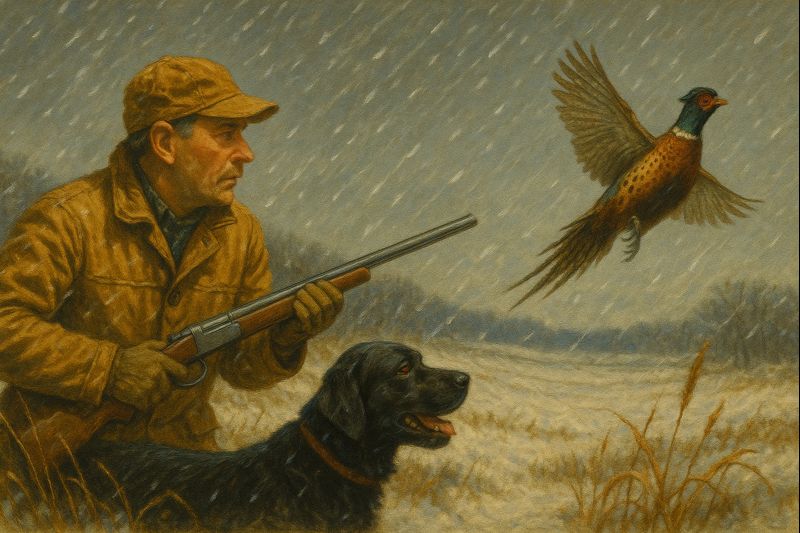
The rooster flushed wild and hard, just a streak of cinnamon and copper ripping through the frosted cattails, long before the dog had even worked the scent cone. It was the kind of flush that sends a tremor through the quiet morning; the kind that reminds you pheasants aren’t gentle, barnyard birds. They’re survivors. Fighters. Veterans of the prairie.
And on that particular Christmas Eve, with the sun still crawling toward the horizon and the temperature dropping by the minute, I felt like I was chasing ghosts across an empty winter world.
The dog, a thick-coated black Lab named Boone, bounded after the bird with a youthful eagerness that didn’t match the white whiskers around his muzzle. He plowed through the cattails like a snowplow made of muscle and memory.
“Easy, boy,” I whispered, even though I knew he couldn’t hear me through the wind.
The sky held that look only December can claim: a flat pale canvas stretched tight over the prairie, quiet and ominous, as if waiting for something. The storm warnings had been buzzing across the radio all week, but when Christmas Eve rolls around, and you’ve got a tradition older than your first shotgun, you lace up the boots anyway.
A hunt on December 24th is a strange mix of ritual and rebellion. It’s a way to honor the season while escaping it at the same time. Some guys go to candlelight service while some watch football. Others hide in their garages wrapping presents at the last second.
Me? I chase roosters.
Boone’s tail suddenly stiffened. He lowered his nose and crab-walked through the thicket with deliberate slowness.
Another bird was nearby.
I eased the shotgun to my shoulder, breath fogging in the cold. Gusts of wind rushed past my face as I tried to keep myself from blinking.
The rooster blew out of the grass in a burst of wings and snow-dust; straight away, quartering right. A perfect, clean shot.
The trigger broke, the tungsten load echoed loudly through the frozen morning, and the bird folded neatly into the drifts.
Boone bounded ahead, slammed into the powder, and emerged with the rooster held proudly in his mouth.
“Good boy,” I said, rubbing the frost from his fur. The bird was heavy and thick, a combination of late-season muscle and fat. A trophy wild bird through and through.
That’s when I felt it.
A shift in the air. A tightening. A sense of stillness so complete it steals your breath before you understand why.
The first snowflake hit the back of my glove like an icy ember.
The storm was early.
Snowstorms on the prairie don’t behave like storms anywhere else. In the mountains, you hear them coming. In the woods, you feel the wind in the branches. But on open grassland, winter drops like a curtain. It’s sudden, silent, and merciless.
Within minutes, the sky went from pale gray to a bruised winter violet. Snowflakes thickened into swirling sheets. And the temperature plummeted so fast it felt like the warmth was being vacuumed straight out of the air.
I had a long walk back to the truck. There was over a mile and a half of rolling CRP, cattails, and faint two-tracks that were already disappearing under the storm’s first assault.
Boone looked up at me, tail lowered, sensing the change as well. He gave me a look, almost as if asking what the plan was.
“We better hustle, buddy,” I told him, “I bet we can still get one more bird before it gets too bad.”
I should have turned back. Any experienced hunter would’ve said the same. When visibility drops and the wind starts to churn sideways, the only smart move is to get out.
But Christmas Eve hunts come with their own kind of stubborn magic; and when Boone locked up again on a scent, frozen tail raised like a black flag in the storm, instinct took over.
I walked toward him through knee-deep drifts. Snow whipped across the field like white fire.
The rooster flushed nearly straight up in an explosion of feathers against the darkening sky. For a split second, the world stilled; just me, the bird, Boone, and the falling snow. It was as picturesque a moment as one could imagine.
The shot cracked. Clean. Solid. The bird tumbled into the swirling white.
Boone sprinted ahead, this time disappearing into the storm.
When Boone didn’t return after ten seconds, then twenty, a cold feeling unrelated to the weather slid into my gut.
“Boone! HEEL!”
Nothing.
The wind swallowed my voice.
The snow was now hammering sideways. Visibility was no more than 20 yards. And when I turned to look behind me, the tracks we’d left were already gone, erased in mere seconds.
I took a slow breath.
Panic is a fast killer out here.
I cupped my hands and bellowed again:
“BOOOOOONE!”
This time, a faint bark answered from somewhere deep in the white haze.
I marched toward it, one heavy step at a time, feet sinking into fresh drifts. Each gust felt like it shaved another degree off the world.
Then, suddenly, a dark shape emerged. It was Boone, tail whipping, and a plump rooster in his mouth. His fur was packed with ice. His eyes were blinking through frost.
“Good boy… good boy…” I murmured, taking the bird and giving him a quick check. He was shivering hard. We both were.
It was time to go.
The storm no longer fell, it attacked. Snowflakes stung like sand. The wind keened across the empty prairie like a freight train looking for survivors.
I could no longer see the horizon. Couldn’t even see the truck or where the field ended and the lowlands began.
Getting stuck in a whiteout is like being trapped inside a ping-pong ball; everything looks the same, every direction feels right until it isn’t.
I trusted my internal compass. Turns out that was the wrong decision.
After fifteen minutes of walking, I noticed the slope of the land was wrong. We were moving downhill toward the cattail slough instead of back toward the section road. My heart was beating faster now. This was the type of weather that brought on frostbite faster than one would even have time to react. I needed to find shelter, and fast.
Boone stumbled beside me. His breathing was shallow, chest heaving. His coat, although built for this kind of weather, was still losing the battle.
Suddenly, a dark shape emerged through the blowing snow.
At first I thought it was just another stand of cattails bending under the wind, but as I squinted through the white haze, the shape held. Straight edges. A slanted roofline. Solid.
A shed.
The sight of it stopped me cold.
There weren’t supposed to be any buildings out here, not this far back. I was deep in public ground, miles from the nearest road, let alone a homestead. I’d hunted this tract for years and never once seen a structure standing where the prairie met the marsh.
But the storm was closing in fast, and curiosity had no place in that moment.
The wind was howling now, snow driving sideways hard enough to sting exposed skin. Boone pressed close to my leg, his head low, eyes blinking through ice.
“Let’s go, boy,” I said, raising my voice above the wind and pointing toward the dark outline.
The shed was nothing fancy; just old, weathered boards, half-buried in snow, its door hanging crooked on rusted hinges. But it was standing, and it was shelter.
Inside, the wind died instantly.
The change was so abrupt it felt unnatural. It was like stepping through a doorway into a different world. One moment the storm was screaming, clawing at everything it touched, and the next it was reduced to a distant, muted presence, its violence softened to a low, steady hiss against the boards.
The air inside smelled old. Dry wood, dust, and something faintly sweet, like hay that hadn’t been disturbed in years. The floor was packed earth, hard as stone from countless winters. Light crept in through thin cracks between the boards, turning the drifting snow outside into pale slashes that moved slowly across the walls as the storm shifted.
Boone circled once, then twice, before settling against my leg with a tired sigh. His body pressed warm and solid against mine, the foil blanket crackling softly as he tucked his nose beneath it. The hard shivering that had rattled him earlier faded, replaced by a deep, even breathing that told me he was finally warming up.
I rested a gloved hand on his side and leaned back against the wall.
The shed groaned now and then; not in protest, but like something old adjusting its weight. The sound wasn’t unsettling. If anything, it felt reassuring, like the structure knew exactly what it was built for.
Outside, the wind began to lose its edge. The sharp rattling against the boards faded into something gentler, almost rhythmic. Snow tapped softly now, no longer striking with force, but falling straight down, quiet and patient.
I don’t remember closing my eyes, but I remember opening them.
When I finally stood, my joints protested, stiff from cold and stillness. I pushed the door open slowly, half expecting the wind to rush back in.
It didn’t.
The storm had passed.
“Let’s get home, pal.”
The prairie outside lay transformed, smoothed and softened beneath a fresh blanket of snow. The sky had lightened to a pale winter gray, and the air carried that clean, hushed silence that follows a heavy snowfall. I took a few steps forward and stopped.
There, about fifty yards away, sat the truck.
For a long moment, I simply stared. The distance didn’t make sense. The walk had felt endless. Disorienting. I would’ve sworn we’d wandered far off course.
Boone didn’t hesitate. He wagged his tail and headed toward the truck as if the morning had unfolded exactly as planned.
I followed.
When I reached the driver’s door and reached for the handle, I paused and looked back over my shoulder toward the spot where the shed stood.
It wasn’t there.
No dark shape.
No roofline.
No weathered boards.
Only open prairie and untouched snow, smooth and unbroken, stretching to the horizon as though nothing had ever stood there at all.
I loaded Boone into the cab, shut the door, and turned the key. As the engine came to life, I didn’t even try to make sense of what happened.
After all, some things aren’t meant to be explained.
Especially on Christmas Eve.
THE END
This story is a fictional entry from “Campfire Tales from Black River Shot Co.”, our classic-style hunting story series inspired by the golden era of outdoor writing.